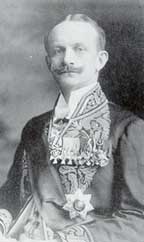

Don Rodrigo de Arista Y Potestad, Conde de Albrit is a Spanish Count with a long name and a long line of disgraces. He lived in Peru trying to recover a gold mine that belonged to his ancestors. However, this was in vain; ruined, he returns to Spain. There he will come to know that his son is very ill due to the suffering inflicted by his North Amerikan wife, an impudent woman who lives a frivolous life, a usual custom among those frauleins from such savage land.
When the Conde de Albrit’s son dies, the old man reads in a letter written by his son that one of his beloved granddaughters don’t belong to the Albrit stock. Since that infant is the result of the dissipated life of his daughter-in-love, from that moment on, Conde de Albrit only will have one aim. That’s to find out which one of his granddaughters are real Albrit descendents and which are not.
As usual in Herr José Buchs career, “El Abuelo” was an adaptation of a novel of a reputed Spanish writer, Herr Benito Pérez Galdós. Due to those literary roots, the film has a lot of intertitles ( a characteristic not exclusive of Herr Buchs films but also Spanish silent films ). The images depend on literary quotes. This is a strange and silent habit in the Spanish silent era in where the technical experimentations were nonexistent and the films were a consecutive and illustrative show of images.
The film is also full of performances as stiff as Conde de Albrit’s beard. In order to get the full old story about dishonour and other bizarre Spanish behaviours included, the film is a long, dull two hours ( another habit of the Spanish silent era and probably inherited from the Inquisition’s times… that is to say, to extend the pain to the victim). It is a film that any longhaired forgets easily due to its lack of artistic interest and showy story.
And now, if you'll allow me, I must temporarily take my leave because this German Count must know which one of his fat heiresses is the richest one… without any regard to ancestry.
Herr Graf Ferdinand Von Galitzien
-/-
Don Rodrigo de Arista Y Potestad, Conde de Albrit, es un conde hispánico que además de poseer tan largo nombre también ha sufrido una larga sucesión de desgracias; vivió en Perú intentando recuperar una mina de oro que pertenecía a sus antepasados aunque sin fortuna para él, arruinado, decide volver a Hispania; en dicho país tendrá noticia de que su hijo está muy enfermo debido a los sufrimientos que le ha dado su esposa norteamericana, una mujer desvergonzada de vida licenciosa, en lo que parece ser una conducta habitual entre esas frauleins provenientes de tan salvajes tierras.
Cuando el hijo del Conde de Albrit fallece, su padre lee en una carta escrita por su vástago que una de sus queridas nietas no pertenece al linaje de los Albrit de toda la vida pues dicho infante es el resultado de la vida disipada de su nuera; a partir de entonces, el Conde de Albrit solamente vivirá para un propósito: averiguar cual de sus nietas es una auténtica Albrit y cual no.
Como era habitual en la filmografía de Herr José Buchs, “El Abuelo” es una adaptación de una obra de un reputado escritor hispánico, en este caso Herr Benito Pérez Galdos; debido a esos orígenes literarios, el filme tiene numerosísimos rótulos ( una característica no exclusiva de la obra de Herr Buchs sino de los filmes silentes hispánicos ), dependiendo demasiado las imágenes de dichas citas literarias, extraño y habitual hábito silente hispánico éste en donde las innovaciones técnicas era inexistentes y los filmes una consecutiva galería de insulsas imagines.
El filme también está repleto de interpretaciones tan acartonadas como la barba del Conde de Albrit, sin olvidarse de que tan apolillada historia sobre honores perdidos y demás extrañas costumbres hispanas son expuestas en un filme de larguísima y aburrida duración, casi dos horas en lo que parece ser otra costumbre de la era silente hispánica heredada ésta vez de los tiempos de la Inquisición, al prolongar en el tiempo el dolor a la víctima en cuestión… en definitiva, estamos ante un filme que cualquier melenudo olvidará fácilmente debido a su falta de interés artístico y ñoña historia decimonónica.
Y ahora si me lo permiten les tengo que dejar momentáneamente, pues este Conde germánico tiene que averiguar cual de sus gordas herederas teutonas es la más rica, sin tener demasiado en cuesta su pedigrí aristocrático.
Herr Graf Ferdinand Von Galitzien


