Freitag, März 30, 2007

"Au Secours!" (1924) By Abel Gance


Au Secours!” is a frenchified film that is a collaboration of two of the most important silent film personalities of that European country: Herr Abel Gance und Herr Max Linder.

For Herr Gance to direct this two reel comedy was a kind of break after the contrarieties and problems during the filming of “La Roue” (1923) and before he began another complicated and colossal film project, “Napoléon” (1927), so, “Au Secours!” was an amusing trifle filmed between masterpieces, two film milestones in the silent film history. For Herr Linder, this film was his next to last film before he decided to leave this cruel world.

The original idea of the film was Max Linder’s who was a close friend of Herr Gance. It's not a very original idea for a comedy: Herr Max accepts a bet to spend an hour in a haunted house in order to win 1.000 francs, but there's a funny and surprising finale. In spite of “Au Secours!” being merely a divertimento, it has excellent examples of the superb Herr Gance’s cinematic achievements and techniques; for example, when Herr Max is clinging to a chandelier the image is distorted in different ways to give the illusion of vertigo. And there is also a fascinating travelling shot when Herr Max is entering the house, a shot that shows us the terrors awaiting the unknowing hero.

The comedy works perfectly well at the service of an efficient Herr Linder who will have to deal with a crowded haunted house full of strange devices and monsters, not to mention the great variety of animals that are in there ( hypos, hyenas, snakes, crocodiles, tigers… ), giving the impression that it is more of a zoo than a haunted house.

And now, if you'll allow me, I must temporarily take my leave because this German Count must ask for more daily help.

Herr Graf Ferdinand Von Galitzien

-/-


El filme “Au Secours!” es un filme afrancesado en el cual colaboraron dos de las más importantes celebridades con las cuales ha contribuido, para gloria e historia del cinematógrafo, dicho país europeo: Herr Abel Gance und Herr Max Linder.

Para Herr Gance dirigir este mediometraje cómico supuso una especie de descanso después de las contrariedades y problemas que tuvo que soportar durante el rodaje de “La Roue” (1923) nimiedades éstas en comparación con lo que posteriormente le estaba esperaba, el también complicado y colosal rodaje de “Napoleón” (1927), por lo que podemos decir que “Au Secours!” fue un divertido pasatiempo filmado entre dos obras maestras fundamentales de la historia muda y del cinematógrafo.
Para Herr Linder este fue su penúltimo filme antes de que decidiese dejar éste mundo cruel.

La idea original del filme fue obra de Herr Linder, amigo íntimo de Herr Gance, y aunque no se trata, ciertamente, de una idea demasiado original para una comedia ( Herr Max acepta una apuesta que consiste en pasar una hora en una casa encantada, si lo logra ganará la apreciable suma de 1.000 francos ) pero posee un divertido y sorprendente final.
Aunque “Au Secours!” sea un simple divertimento, en el filme se pueden encontrar excelentes ejemplos de los magníficos logros y la depurada técnica cinematográfica de Herr Gance, como por ejemplo, cuando Herr Max se halla colgado de una lámpara y la imagen se distorsiona en múltiples formas para dar sensación de vértigo al espectador, o el fascinante travelling cuando el protagonista se dispone a entrar en la casa encantada, transmitiendo al espectador la sensación de que un desconocido e inminente peligro le está esperando.

Como comedia funciona perfectamente y es idónea para el siempre eficiente Herr Linder, el cual tendrá que soportar una enorme variedad de extrañas trampas y monstruos, además de multitud de animales que deambulan por allí dentro ( hipopótamos, hienas, cocodrilos, serpientes, tigres... ), dando la impresión de antes que una casa encantada, eso parece más bien un zoológico.

Y ahora si me lo permiten les tengo que dejar momentáneamente, pues este Conde germánico tiene que solicitar más ayuda doméstica.

Herr Graf Ferdinand Von Gali
tzien

Mittwoch, März 28, 2007

Silent Films Illustrated With Commentaries By:

About Alexander Volkoff’s “Kean” (1924)

Silent Guest Star: Herr MikeGebert Und Herr Kino Eye

Herr MikeGebert wrote: “Thought of Kean last night while watching James Whale's The Great Garrick; they both have a certain larkish approach to portraying a great actor as a big playful ham (a tiger costume figures prominently), though Kean takes it into more traditional biopic territory (including, as you note, one of the screen's most protracted death scenes).
The most intriuging thing about Kean to me was a scene of rapid cutting, a la Napoleon (on which Volkoff worked), a dance number which turns kaleidoscopic in a frenzy of edits only a frame or two long. In Film Comment around 1980, Michael Powell (who was working for Rex Ingram in Nice at the time Volkoff and the other White Russians were making their exile films in France) wrote that when he first saw it in 1924, the audience held up their chairs to prevent the film being shown further until the projectionist agreed to rewind it and replay this sequence. (I think he said they did the same for the dinner-roll dance in The Gold Rush.)

As I wrote back in livelier days on poor a.m.s.:
"I have often wondered whether the origins of extreme rapid cutting as a style might not be lost in the lost work of Gance's assistants (who were quite prominent directors in their own right), the White Russian emigres Alexander Volkoff and V. Tourjansky. I have no proof of this, but they leave Russia for France and in no time rapid cutting appears simultaneously in a) their pal Gance's films, b) their own films (such as Volkoff's Kean), and c) in the cinema of Russians they had worked with who stayed behind. An interesting coincidence, no? More plausible than the conventional explanation, which is that Gance invented it for La Roue and oh by the way, it also got invented separately (with a whole theoretical apparatus behind it) in Russia by people who watched Intolerance over and over. "

Und Herr Kino Eye added: “Here's my review on Kean and the film Mosjoukine was in before, Burning Crucible. ( At this time, Herr MikeGebert confirmed to him. “Though German, also directed by Volkoff )

In regard to the dance sequence you mention, Mosjoukine was in a German film, the White Devil, which besides being a pretty good film, has a show-stopping dance sequence, which as I remember, has a MOTIVATED (that is, the shot made sense in context of the scene), complete TRIPLE 360 degree pan shot, a shot I've never seen done in any other film. I've only seen the film once, so would have to watch the film again to be sure what was happening, but whatever it was, it was a coup de cinema.

Mosjoukine directed his next film, Le Brasier ardent [The Burning Crucible] (1923), a surreal fantasy about a couple with marital problems. After a fight the wife, Elle, leaves the house. The husband, a wealthy industrialist, follows his wife to a private club, which turns out to be an Alice-down-the-rabbit-hole adventure full of hidden doors and secret passageways. Eventually the husband hires "Detective Z" (Mosjoukine, who also plays at least four other roles) as a 'love consultant' in an attempt to win back his wife. Detective Z responds to this challenge by first flirting with Elle, and then abandoning the effort to go home with a toothache. Somehow this intervention returns Elle to her husband and we have a happy ending. Le Brasier Ardent is full of crazy kinetic energy, but there is also a brittle coldness to the film since there is little time invested to give any empathy to the characters.

Mosjoukine would never again be in the position of creating such a plum part for himself where he could play so many multiple characters, but in 1924 he did the next best thing by starring in a movie about a famous stage actor, Kean. Edmund Kean was famous for being one of the first English actors to have such broad popularity that his fame crossed both class and geographic boundaries. One must remember that in Europe, the acting profession was once regarded with suspicion and distaste. In Shakespeare's day, actors were considered only slightly better than the bear baiters competing for crowds outside the Globe. Kean helped elevate the profession into what would be celebrity status for later performers such as Henry Irving. Mosjoukine plays the actor as a tortured romantic genius, denied his one true love by a jealous husband. This lets Mosjoukine have some delicious business such as when Kean is stopped in his efforts to see his love and then must go out and play Hamlet. Mosjoukine plays the scene on at least two levels - a spurned actor almost mad with rage playing a Danish prince also raging against the world”.

And then Herr Graf Ferdinand Von Galitzien commented: “This German count shares ( a bizarre fact this, the aristocracy sharing something with the ordinary people... ) such suspicions about those White Russians rapid cutting influences in Herr Abel Gance work; probably the French director was the first one to use that editing in a proper way, that is to say, in dramatic film terms, a fact this that would be developed years later by those Bolshevist and well-know directors as Herr Eisenstein, so finally "la roue" has come full circle.

This German Count appreciates ( a rare fact this, the aristocracy appreciating something from the ordinary people ) Herr Gebert und Herr Kino's old comments ( almost as old as this German aristocrat ) about "Kean" and Moskoujine peculiarities”.

Finally Herr Kino Eye suggested: “Perhaps we should have a film festival, with a clip of a The White Devil's Triple 360 degree pan, followed by La Roue, followed by Ophul's La Ronde, (or should we use the original title, "Reigen"?) followed by a week being treated for a motion sickness disorder”.

Published in “alt.movies.silent”.

Montag, März 26, 2007

"Kean" (1924) By Alexandre Volkoff

“Kean” was a French film production which tells the story of Herr Kean, a very important British actor who specialized in Shakespeare's oeuvres. Kean has a lot of admirers; among them a married Countess ( an ordinary subject this, that is to say, aristocrats will flirt on any occasion ) . The production includes a lot of Russian émigrés ; Herr Alexander Volkof directed and Herr Ivan Mosjoukine was the star ( both collaborated closely during those silent years in many films ). Unfortunately, with such bizarre combinations of nationalities and revolutionary intentions, the final result is colourless, dispersed.

Star Mosjoukine, one of the most important and famous Russian actors, has a certain tendency to overact, and fails to bring to his character the touch of irony necessary to make believable this British actor's fame and success among the ladies. A more noteworthy performance comes from Dame Nathalie Lissenko who plays the Countess of Keofeld, more realized and with plenty of those shades that make very attractive her character to the audience. She's an idle aristocratic woman ( another ordinary subject among the aristocracy ) who uses Kean for her own purposes.

Probably those different and contrasting performances are due to the script, on which the same Mosjoukine also collaborated and is based on a novel of the French writer Herr Alexandre Dumas. The story is not developed and is too focused on the principal but superficially drawn character and gives no chance or in depth study to the gallery of other very important actors in the film. For example, the interesting character of Dame Juliet ( Pauline Po ), a Kean admirer, suddenly disappears from the film leaving her intriguing relationship with Kean unresolved.

The most interesting aspect of the film is its cyclic structure; it begins with a theatrical performance of Shakespeare’s “Romeo And Juliet”, those passionate lovers who will end up badly and the film finishes with another tragedy, this time “Hamlet” by the same English author; fiction and reality are thus intertwined, , harmonizing tragic fiction and tragic reality. Literature and reality end in the same way with the difference that Romeo dies quickly and Kean takes half the film to do so....

A curious and cosmopolitan European film production, “Kean” is one of those arty works, an “oeuvre de qualité”, so dear to the heart of Herr Volkoff ( he is the art director of the film ), but the lavish décor is merely a distraction from the emptiness of the movie.
And now, if you'll allow me, I must temporarily take my leave because this German Count must recite Schiller verses to his idle German heiresses.

Herr Graf Ferdinand Von Galitzien


-/-


El filme silente “Kean” es toda una producción francesa que nos narra la historia de, evidentemente, Herr Kean, un importante actor inglés especializado en las obras teatrales de Shakespeare; Kean tiene por esas circunstancias, muchísimas admiradoras y entre ellas a una condesa casada ( una ordinaria cuestión el hecho de que los aristócratas flirteen a la mínima ocasión )…; dicha producción afrancesada fue realizada por un buen números de emigrantes rusos, incluyendo al director, Herr Alexander Volkoff y a su actor principal, Herr Ivan Mosjoukine, colaborando ambos en otras producciones silentes durante esos años; desafortunadamente tan bizarra combinación de nacionalidades e intenciones revolucionarias, consiguieron un resultado final muy desganado y disperso.

Herr Mosjoukine era por entonces considerado como uno de los más importantes actores rusos a pesar de su tendencia a la sobreactuación, no consiguiendo, por dicho motivo en este filme, insuflar a su personaje la suficiente ironía y profundidad para hacer creíble el porqué de tanta fama entre las mujeres de su personaje.
En el lado opuesto tenemos a la actriz Dame Nathalie Lissenko que interpreta al personaje de la condesa de Keofeld de una forma ciertamente magnífica, consiguiendo transmitir todos los matices y peculiaridades de dicho personaje, esto es, una ociosa aristócrata ( otra ordinaria cuestión entre la aristocracia ) que usará a Kean para sus propios intereses.

Quizás esas diferentes y opuestas interpretaciones se deban al guión en el cual el mismo Mosjoukine colaboró y que está basado en una novela del escritor francés Herr Alexandre Dumas, no desarrollando en profundidad sus personajes además de estar demasiado centrado en su actor principal, muy desdibujado éste no dando opción a la galería de intérpretes que deambulan por el filme, como, por ejemplo, Dame Juliet ( Paulien Po ), una admiradora de Kean que de repente desaparece del filme cuando su intrigante relación con el actor inglés se ponía interesante..

Lo más destacable del filme es su estructura cíclica, comenzado con una representación teatral de una obra de Shakespeare, “Romeo Y Julieta”, esos apasionados amantes que acabarán sus existencias de forma trágica y finalizando el mismo con otra representación teatral, “Hamlet” del mismo autor inglés.
Ficción y realidad se entrecruzan y enlazan, armonizando ficción y trágica realidad, una paradoja silente, la literatura y la vida acaban de la misma forma parar sus principales protagonistas, con la única diferencia de que Romeo muere de forma fulminante y a Kean le lleva media película hacerlo…

En resumen, “Kean” es una curiosa y cosmopolita producción europea, uno de esos filmes artísticos u “oeuvre de qualité” que tanto gustaba Herr Volkoff ( director artístico también del filme ), aunque tan sugerentes decorados son simplemente una distracción para el vacío argumental que impera en el filme.

Y ahora si me lo permiten les tengo que dejar momentáneamente, pues este Conde germánico tiene que recita versos de Schiller a una de sus ociosas herederas germánicas.

Herr Graf Ferdinand Von Galitzien

Donnerstag, März 22, 2007

"The Scarlet Car" (1917) By Joseph DeGrasse


“The Scarlet Car”, a film directed by Herr Joseph DeGrasse, older brother of the actor Sam DeGrasse, who obviously plays a role in this film ( in what is a good example of Amerikan nepotism… ), tells a story about bankers and crooks ( both concepts are synonymous, certainly… ) and murder and matrimony ( include here the same German comments of a moment ago ).

For the aristocracy and silent fans the most interesting aspect of this film is that it is one of Herr Chaney's earliest surviving films.
Herr Chaney has a small but very important and decisive role, playing a bank cashier, Paul Revere Forbes, that works for two crooked bankers, Ernst and Cyrus Peabody ( Howard Crampton and Sam DeGrasse ), father and son respectively; they forge the bank's money and Herr Forbes knows everything about this; in order to have no trouble, the crooked bankers murder Forbes, not knowing that in this way they get involved in more troubles…

Anyway Herr Chaney is so great playing his characters, even the early ones, that he plays dead superbly in the film in order to put things right, incidentally marrying his daughter Beatrice ( Edith Johnson ) to Billy Winthrop ( Franklyn Farnum ), a promising business man.

The film has a certain and delightful scent of the past, including memories of old battles and such typical local customs as tarring and feathering people, peculiar scenes of a small Amerikan village, certainly… this film seems also to be an episode of one of those early silent serials in its concept and with its narrative, including two illuminating flashbacks for the service of a final thrilling climax.

And now, if you'll allow me, I must temporarily take my leave because this German Count must check that the bank accounts of his fat and rich German heiresses are in order.

Herr Graf Ferdinand Von Galitzien


-/-


El filme “The Scarlet Car” fue dirigido por Herr Joseph DeGrasse, hermano mayor del actor Sam DeGrasse el cual, obviamente, participa en dicho filme en lo que es un claro de nepotismo americano… y nos narra una historia acerca de banqueros y ladrones ( ambos conceptos son sinónimos, ciertamente… ) además de asesinatos y matrimonio ( incluir aquí los mismos comentarios germánicos de hace un momento ).

Para la aristocracia y los admiradores del cinema silente, el más interesante aspecto de dicha obra es que se trata de uno de los primeros trabajos de Herr Lon Chaney que han sobrevivido el paso de los tiempos; Herr Chaney tiene un pequeño pero importante papel en dicho filme, interpretando a un cajero de banco, Paul Revere Forbes, que trabaja para dos corruptos banqueros, Ernts y Cyrus Peabody ( Howard Crampton y Sam DeGrasse ) padre e hijo, respectivamente; ambos dos falsificaron dinero del banco y Herr Forbes conoce todos los detalles de tan ilegal operación; para evitar problemas, los banqueros corruptos deciden eliminar a Forbes, sin saber que de esa forma se iban a ver envueltos igualmente en numerosísimos problemas.

Herr Chaney es tan especial interpretando a sus personajes, incluso los primerizos, que incluso hace el muerto de forma gloriosa en dicha obra, un hecho éste que de forma casual ayudará a que finalmente pueda casar a su hija Beatrice ( Edith Johnson ) con Billy Winthrop ( Franklyn Farnum ), un prometedor hombre de negocios.

El filme tiene un cierta y encantadora atmósfera del pasado, además de incluir en sus escenas recuerdos de batallas antiguas y típicas costumbres nativas como emplumar a sus convecinos, peculiar escenas éstas de esos pueblos americanos, ciertamente…
El filme se antoja un episodio de esos primerizos seriales silentes tanto en su concepto como en su narrativa, en los cuales se incluyen dos esclarecedores flashbacks, todo ello al servicio de un emocionante final.

Y ahora si me lo permiten les tengo que dejar momentáneamente, pues este Conde germánico tiene que comprobar que el estado de las cuentas bancarias de sus ricas y gordas herederas teutonas, están en orden.

Herr Graf Ferdinand Von Galitzien

Dienstag, März 20, 2007

Gas: "O Dezaseis"

MEIN GOTT!!!...

A very important German secret has been revealed!!... even worse, a longhaired Amerikan reporter has been given access to the favourite non-German restaurant of this aristocrat, a place in where this Teutonic count goes on any occasion accompanied by his rich and fat heiresses in order that they pay the bill, natürlich!.

Now you know why those heiresses accompanying this German count are fat - and that's the best publicity for "O Dezaseis", certainly.

Herr Graf Ferdinand Von Galitzien

-/-


MEIN GOTT!!!...

Un importantísimo segredo xermánico foi finalmente desvelado!... e ainda moito pior, un xornalista melenudo americano tivo acceso ó restaurante favorito e non xermánico deste aristócrata, un lugar a onde éste Conde teutónico acode sempre que pode e na compaña das súas ricas e gordas herdeiras, pra que éstas últimas paguen a conta, natürlich!.

Agora xa saben vostedes o porqué esas gordas herdeiras están tan gordas, e esa é dende logo a mellor publicidade que se lle pode facer a "O Dezaseis".

Herr Graf Ferdinand Von Galitzien

Montag, März 19, 2007

"The Trap" (1922) By Robert Thornby


Last night, was another silent, bizarre and Teutonic night in the Schloss, a soirée in which “The Trap”, a film directed by Herr Robert Thornby in the silent year of 1922 was shown.

This German count, thanks to his aristocratic breeding, knows very well elegant languages such as German or Teutonic but that wasn’t enough to comprehend the strange language in which were written the majority of the inter-titles of this film (set in the surroundings of Canadian Northwest).

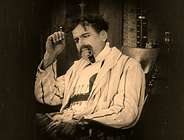
Thanks to an elderly and learned unit specializing in dead Amerikan languages whose specialty it is to decipher such strange and enigmatic letters, the film plot was revealed to this German Count. It depicts the story of Gaspard (Lon Chaney), an innocent and ignorant fur trapper. He owns a mine and loves Thalie (Dagmar Godowsky). However, he will be ultimately fooled by Benson (Alan Hale) who keeps the mine and the girl.

From that moment on, Gaspard only lives for taking revenge on both of them.

In spite the strange language that Gaspard speaks, it wasn’t a problem for this German Count to enjoy another brilliant and classic Herr Lon Chaney performance. “The Trap” is a film in which his many facial expressions and body language are brilliantly displayed.

Gaspard, a good and simple man will be transformed in a fiend with no limits to accomplish his vengeance. As he said to his enemy, again according to the Amerikan dead languages experts unit: “wen you steal my mine, an’ my gal, I t’ink firs’ to keel you, but I know if I keel you quick, you not suffaire lak me.” It seems that inner human transformation is not a problem to Herr Chaney, it’s so easy for the audience to watch his acting merits. Paradoxically, Gaspard finally will be the avenged avenger, the trap trapped.

And now, if you'll allow me, I must temporarily take my leave because this German Count doesn’t talk the same language.

Herr Graf Ferdinand Von Galitzien
-/-

La pasada noche, fue otra noche silente, bizarra y teutónica en el Schloss, una soirée en la cual el filme “The Trap”, dirigido por Herr Robert Thornby en el año silente de 1922 fue exhibido en el teatro aristocrático.

Este Conde germánico, gracias a su educación aristocrática, ha sido educado en idiomas elegantes tales como el germánico o el teutónico, pero de todas formas, esa formación no ha sido suficiente para comprender extrañas lenguas tales como la que se pueden apreciar en el filme anteriormente mencionado y en la cual están escritas prácticamente la mayoría de los intertítulos del filme en cuestión, un filme por cierto, ambientado en los alrededores del noroeste canadiense.

Gracias a los sabios y doctos expertos germánicos especializados en lenguas muertas americanas al servicio de éste Herr Graf, cuya especialidad es descifrar extrañas y enigmáticas letras de aquellos recónditos parajes, la trama del filme fue finalmente descifrada para éste Conde germánico, historia en la cual se nos narra las peripecias de Gaspard ( Lon Chaney ), un inocente e ignorante cazador de pieles que posee una mina en aquellos lejanos parajes y que además ama a Thalie ( Dagmar Godowsky ); el interfecto será finalmente engañado por Benson ( Alan Hale ) el cual se quedará con su mina y con su chica.
Desde ese mismo instante, Gaspard solamente vivirá para vengarse de ambos.

A pesar del extraño idioma que habla Gaspard, ello no fue ningún problema para que este conde germánico disfrutase de otra memorable y clásica interpretación de Herr Lon Chaney; “The Trap” es una obra en la cual el lenguaje corporal y la interpretación del actor americano se expone de forma esplendorosa en el filme.

Gaspard, un hombre bueno e ingenuo, se transformará en una persona malvada que no conocerá límites para llevar a cabo su venganza y así se lo hace saber a su acérrimo enemigo en una secuencia del filme, de acuerdo con los expertos anteriormente citados en lenguas muertas americanas: “Cuando usté me afanó la mina y mi churri, pensé en liquidarlo al instante, pero desa forma usté no sufriría tanto he sufrío llo”.
Esa transformación pérfida y humana, parece no ser ningún problema para Herr Chaney, dándole la impresión al público de que dicha transformación interpretativa parece algo muy sencillo… por cierto, Gaspard finalmente será el vengador vengado, el acosador acosado.

Y ahora si me lo permiten les tengo que dejar momentáneamente, pues este Conde germánico se ha quedado sin palabras.

Herr Graf Ferdinand Von Galitzien

Mittwoch, März 14, 2007

Silent Films Illustrated With Commentaries By:

About Irving Cummings' "Flesh And Blood" (1922)

Silent Guest Star: Rich Wagner

Herr Rich Wagner exclaimed: "Well Herr Graf, you're talking about an old favorite of mine that I must have watched at least a dozen times, but haven't seen in at least eight years. It was the first time that I actually got a good look at 'Herr Chaney's' pitiful and sorrowful facial expressions. No wonder the poor man never got the girl.

My only question to your post was you referring to this innocent man as a criminal? Here's the story from memory, so it might even be better than the film.
An innocent man, caught in the fangs of an unjust world, he's befriended by the Chinese who assist in his escape so he could see his sickly wife, but alas, she has died. Heartbroken and seeking revenge, with the Chinese help, he manages to befriend his own daughter without her even knowing who he was. Just as he's ready to plan his revenge against his former partner, he learns that the man's son is sweet on his daughter. He learns that the former partner is going to destroy the happy couple, so he strikes a deal; your son or your life. The man backs off and the daughter finds happiness in the arms of her lover. What's that saying about the apple not falling too far from the tree?

Anyway, when Herr Gaff wrote about this, the good Count omitted the final intertitle that says something like, "A man can sometimes be free behind bars."
I'm sure that's not correct (perhaps you could post it correctly?), but it was a typical softhearted film, much like many other Chancy films".

Und Herr Graf Ferdinand Von Galitzien answered: "Mein lieber Herr Wagner ( Herr Richard's family, this German Count presumes.. ):
Well, this German count was referring about David Wester ( Herr Lon Chaney ) that he was wrongfully incarcerated for a crime he didn't commit, and probably the right word in this case would be "offence" but in any case this German Count didn't named Herr Chaney a "criminal", heaven forbid!!... Obviously those misunderstandings were due Gunthell's simultaneous translation from German to Amerikan ( can't you hear from there asking his master for mercy?? ... )

Good Wester-Chaney says in the next to last intertitle: "I went out a hunted and marked man; I come back, free!" and the last one says: "Strange are the paths men tread to happiness".

"the good Count"... is this an Amerikan pun??!!

Finally Herr Rich Wagner added: "While it's not an 'Amerikan pun,' it was my rather inept way of trying to get a response to my question. You of course, obliged me with an answer.
Thank you for helping me to recall the final words in an old favorite of mine".


Published in "alt.movies.silent".

Montag, März 12, 2007

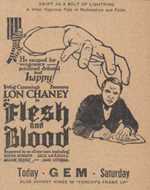
"Flesh And Blood" (1922) By Irving Cummings


It is well-know for centuries that the aristocracy have little moods and bouts of indecisiveness; characteristics that are even more pronounced if those aristocrats are Germans (like this Count who besides being German is also Teutonic). Anyway, these contradictions assaulted this German Count while watching “Flesh And Blood,” a film directed by Herr Irving Cummings in the silent year of 1922, starring the great Amerikan actor Herr Lon Chaney.

The film depicts the story of a poor lawyer ( first contradiction or a German pun? ), David Wester ( Lon Chaney ) wrongfully incarcerated for a crime he didn’t commit, his conviction being the fault of a businessman, Fletcher Burton ( Ralph Lewis ) Wester escapes from jail to seek revenge on Burton.

However, aristocrat David Wester’s vengeance is very soft and mild ( the convict will back down from his purpose for the sake of his daughter who is engaged to his enemy’s son ) and because finally the stolen money will be used to build one of those Catholic ( not Lutherans ) missions and what's more, Wester’s daughter does good works there!!… isn’t that enough punishment?...

Another German contradiction for this German count is that even though Wester spent 15 years in jail unjustly, he finally will not be able to clear his name and will passively return to prison; This means the bad ones wins over the honest people; of course that's what may happen in real life, even in the aristocratic life…

Herr Lon Chaney plays one of those villains with a noble heart, a good and sensitive man, certainly but not very ingenious, because when he was hidden in Chinatown in order to go unnoticed he disguises himself as a cripple, a kind of contortionist in crutches instead of wearing one of those typical Chinese garments. The last German contradiction: the detective Doyle ( DeWitt Jennings ) only seems able to spot Chaney's accomplice, Herr Li Fang ( Noah Beery ).

And now, if you'll allow me, I must temporarily take my leave because this German Count feels contrary.

Herr Graf Ferdinand Von Galitzien


-/-


Es de sobra bien conocido desde centurias, que la aristocracia se caracteriza por sus caprichos e indecisiones, cuestiones éstas aún más acentuadas si hablamos de la aristocracia germánica, cómo, por ejemplo, bien le sucede a éste Conde que además de ser germano es también teutón…, en fin, clásicas contradicciones éstas que asaltaron a éste Conde germánico tras haber visto “Flesh And Blood”, un filme dirigido por Herr Irving Cummings en el año silente de 1922, obra protagonizada por el genial actor americano Herr Lon Chaney.

El filme narra la historia de un pobre abogado ( ¿primera contradicción o juego de palabras germánico? ) David Wester ( Lon Chaney ) que es encarcelado de forma injusta por un crimen que no ha cometido, por culpa de un empresario de nombre Fletcher Burton ( Ralph Lewis ); Wester consigue escapar de la cárcel con el único propósito de vengarse de Burton.

Para este Conde germánico la venganza de David Wester es demasiado taimada y débil ( el convicto no llevará finalmente a cabo su propósito para salvar el matrimonio de su hija con el hijo de su enemigo ) aunque pensándolo bien como finalmente el dinero robado y por el cual fue encarcelado Herr David se empleará para la construcción de una de esas católicas, que no luteranas, misiones americanas, además de que la hija de Herr David trabaja allí, ¿acaso no es ese suficiente castigo para su enemigo?.

Otra germánica contradicción para éste Conde, es que a pesar de que Herr Wester se ha pasado quince años en prisión de forma injusta, finalmente el susodicho no restituirá su honor y de forma complaciente volverá a prisión, esto es, confirmando finalmente que los malos siempre triunfan sobre los buenos, un hecho éste real como la vida misma, incluso la aristocrática…

Herr Lon Chaney interpreta a uno de esos villanos de buen corazón, un hombre sensible aunque no demasiado ingenioso, ciertamente, pues durante su estadía en Chinatown tras salir de la cárcel, no se le ocurre mejor forma para pasar desapercibido que disfrazarse de lisiado, un especie de contorsionista con muletas, en vez de llevar uno de esos típicos trajes chinos, por no mencionar ( última contradicción germánica ) que el detective Doyle ( DeWitt Jennings ) no se da cuenta de nada y solamente tiene ojos para el cómplice de Wester, Herr Li Fang ( Noah Beery ).

Y ahora si me lo permiten les tengo que dejar momentáneamente, pues este Conde germánico se halla con su espíritu de contradicción.

Herr Graf Ferdinand Von Galitzien

Freitag, März 09, 2007

"Die Brüder Schellenberg" (1926) By Karl Grune


After “Eifersucht” (1925), a film recently reviewed mercilessly by this German Count, Herr Karl Grune directed “Die Brüder Schellenberg”, his first film to be produced by the Germany’s greatest film company, “UFA”. It’s a film version of Herr Kellermmann’s eponymous novel, was an important big-budget production and was one of the most successful movies of that silent year.

“Die Brüder Schellenberg” depicts the story of two brothers, Michael and Wenzel, both portrayed by Herr Conrad Veidt, who work at the Raucheisen Steel and Gas company. Michael is a secretary and the other is a head of the central plant. When an explosion in the factory takes the lives of 100 people, both brothers will begin different lives. Michael creates a center for needy people and Wenzel becomes a successful stock exchange speculator.

Most of the film is focused on the ambitious Wenzel, obviously because evil people are more interesting than the dull ones. In this way we can see in the film Wenzel’s life full of luxury and parties instead of Michael’s thrilling works for the poor people.

The film is an urban drama and that’s one of the most interesting aspects of the oeuvre; the film shows those complicated and hazardous days in Germany dealing with huge economic crises and millions of people unemployed. So, the story of the Schellenberg brothers is a kind of reflection of the paradox of the early 20’s in Germany and the different ways to subsist and face up to those times. Wenzel is an unscrupulous man and Michael is idealistic.

In parallel to this, there is a love triangle in the film that reflects the same tale from a feminine perspective. It involves Wenzel (obviously Michael has no time for such trifle love matters… ), Dame Esther Raucheisen (Lil Dagover), daughter of Wenzel’s former boss, a capricious woman who has everything in life, and Dame Jenny Florian (Liane Haid), an ordinary girl who sees in Wenzel’s love, her passport to a new and safe life.

The film is resolves its technical aspects especially when both brothers appear at the same time on the screen. Additionally the scenery and that decor so important in a UFA film production are present. It’s typical of that German company that always had a particular and artistic concern to show German social reality, in a subtle or else over-realistic way.

And now, if you'll allow me, I must temporarily take my leave because this German Count has an appointment at half-passed Veidt.

Herr Graf Ferdinand Von Galitzien


-/-


Tras “Eifersucht” (1925), filme recientemente comentado sin compasión por este Conde germánico, Herr Kart Grune realizó “Die Brüder Schellenberg”, su primer filme producido por la más grande compañía cinematográfica alemana, esto es, la “UFA” y basado en la novela homónima de Herr Kellermmann, una importante producción cinematográfica que supuso uno de los éxitos comerciales de aquel año silente.

“Die Brüder Schellenberg” refleja la historia de dos hermanos, Michael y Wenzel, ambos interpretados por Herr Conrad Veidt y que trabajan en la compañía de gas y acero Raucheisen, uno como secretario y el otro como jefe de la planta central; cuando una explosión en la fábrica se cobra la vida de más de 100 personas, ambos hermanos emprenderán nuevas y diferentes vidas: Michael creará un centro para la gente necesitada y Wenzel comenzará una exitosa carrera como especulador bursátil.

La mayor parte del filme está centrado en las peripecias del ambicioso Wenzel y ello es debido, obviamente.., a que la gente pérfida es siempre más interesante que la ordinaria, gracias a ello podemos ver la vida de fiestas y lujo de Wenzel en vez de los excitantes trabajos de Michael para los necesitados.

El filme es un drama urbano y este es uno de los aspectos más destacables de la obra; el filme muestra esos complicados y peligrosos años en Germania, soportando el país una enorme crisis económica, además de millones de desempleados, por esto mismo, la historia de los hermanos Schellenberg es una especie de reflexión paradójica de los convulsos años 20 en Germania o cómo la gente se las ingeniaba para subsistir o hacer frente a tan penosa época, en éste caso Wenzel como un hombre sin escrúpulos y a Michael como un perfecto idealista.

Paralelamente a la historia, se desarrolla un triángulo amoroso que refleja el mismo problema pero desde una perspectiva femenina, en el cual se ven envueltos Wenzel ( obviamente Michael no tiene tiempo para cuestiones amorosas ), Dame Esther Raucheisen ( Lil Dagover ), hija del antiguo jefe de Wenzel, una mujer caprichosa que lo tiene todo en la vida y Dame Florian ( Liane Haid ), una chica ordinaria que ve en el amor de Wenzel su oportunidad para una nueva y segura vida.

El filme está muy logrado es aspectos técnicos como cuando ambos hermanos aparecen al mismo tiempo en la pantalla, además de los grandes escenarios y fastuosos decorados que se le presuponen a una importante producción de la UFA, una compañía germánica ésta nunca tuvo problemas en reflejar la realidad social de su época, sutilmente o de forma realista.

Y ahora si me lo permiten les tengo que dejar momentáneamente, pues este Conde germánico tiene cita con uno de los hermanos Veidt.

Herr Graf Ferdinand Von Galitzien

Montag, März 05, 2007

"Eifersucht" (1926) By Karl Grune


“Eifersucht” is a stylish “Kammerspiel” film, that is to say,one of those German films stark in setting and focused mainly on the psychological aspects of the story. This one was directed by Herr Karl Grune and is a very interesting film that depicts the degradation of a happy marriage, that supposedly solid and old institution that is not as strong or as important as that other fundamental institution, the aristocracy.

A couple are at the theatre watching a play with a friend who is the author of the oeuvre; at the end of the piece, the jealous husband strangles his wife to death. When the play ends, the man ( Herr Werner Krauss ) talks to his friend ( Herr Georg Alexander ) about such a nonsensical finale, telling the author that no man with any sense ever gets jealous enough to choke his wife in these modern times.The author decides to test this supposedly perfect couple about their happy feelings for each other..

Herr Grune considered this film as a “tragicomedy between man and woman” and it admirably depicts the process of suspicion, uncertainty, misunderstanding and obsession that will put finally bring the married couple to the breaking point. The film includes some allegorical technical effects to enrich the story, but the psychological study of the characters is the most important and remarkable aspect. At this point, this German count must say that the story was written by an important German director, Herr Paul Czinner, who knew very well what was “psychological depth” in a film, and chose to have those afflicted characters played by two excellent actors of those silent Teutonic days, Dame Lya de Putti and Herr Werner Krauss.

This German count remembered that when the film was premiered in the remote 1926 year, some longhaired critics criticized the film for being poorly acted, accusing the cast of incompetence… as it happens, the passing of time is the better judge and proves that those critics were absolutely wrong, because the film maintains in these modern days intact its artistic merit and validity.

And now, if you'll allow me, I must temporarily take my leave because this German Count must be aware of some German heiress’s jealous husband.

Herr Graf Ferdinand Von Galitzien


-/-


“Eifersucht” es un elegante “Kammerspiele”, esto es, uno de esos filmes germánicos carente de grandes alharacas escenográficas y más centrados en los aspectos psicológicos de la historia, un filme dirigido por Herr Karl Grune, en el cual se nos muestra la degradación de un feliz matrimonio, esa supuestamente sólida institución que lógicamente no es tan fuerte o importante como otra fundamental e histórica institución, esto es, la aristocracia.

Una pareja se dispone a ver en un teatro la obra de un amigo de ambos y autor de la misma; durante la representación de la obra y al final de la misma, el actor que interpreta al marido, estrangula a su mujer, consumido por los celos.
Al finalizar la obra teatral, el marido ( Herr Werner Krauss ) le comenta a su amigo ( Herr Georg Alexander ) que el final le parece exagerado, pues ningún hombre en su sano juicio estaría tan celoso de su esposa como para estrangularla, incluso en esos tiempos modernos; el autor de la obra decide entonces poner a prueba a esa supuesta pareja perfecta y sus felices sentimientos mutuos.

Herr Grune consideró en su día éste filme como “una tragicomedia entre el hombre y la mujer”, narrando admirablemente el proceso paulatino de sospechas, incertidumbres, malentendidos y obsesiones, que conseguirán finalmente poner al borde del abismo a tan feliz matrimonio; el filme incluye algunos alegóricos efectos especiales para de esa forma enriquecer la historia, pero el estudio psicológico de sus protagonistas es el aspecto más importante y fundamental del filme; sobre este asunto, este Conde germánico tiene que comentar que el guión de “Eifersucht” fue escrito por otro importante director alemán, Herr Paul Czinner, el cual sabía muy bien ya por entonces a lo que se refería al mostrar la “profundidad psicológica” en un filme, destacando igualmente los dos excelentes actores pertenecientes a esos teutónicos días silentes y que interpretan admirablemente a tan atribulados personajes de la obra, Dame Lya de Putti y Herr Werner Krauss.

Este Conde germánico tiene que mencionar que cuando el filme fue estrenado en el remoto año de 1926, algunos críticos melenudos criticaron el filme por estar mal interpretado, además de acusar a todo el elenco de incompetentes… como suele suceder, el paso del tiempo es el mejor juez, probando finalmente que esos críticos estaban absolutamente equivocados, pues el filme mantiene intacto en estos tiempos modernos, su validez y méritos artísticos.

Y ahora si me lo permiten les tengo que dejar momentáneamente, pues este Conde germánico tiene que tener cuidado con un marido celoso de una de sus teutónicas herederas.

Herr Graf Ferdinand Von Galtizien

Freitag, März 02, 2007

"Le Fantôme Du Moulin Rouge" (1925) By René Clair


Herr Julien Boissel ( George Vaultier ) is a wealthy French businessman who is in love with a rich and French heiress, Dame Yvonne ( Sandra Milovanoff ). Both love each one secretly but pretty soon disgrace will interrupt such passionate love because the president of a yellow newspaper is blackmailing Yvonne’s father, a retired Minister of State. Publication of some delicate, incriminating documents would cause such a big scandal and the newspaper editor wants to marry Yvonne, you see.
Herr Julien, now abandoned by his lover, depressed and grieved, decides to spend a night at the joyful “Moulin Rouge” ( a place in where broad-minded girls dances all night long ) trying to forget his pain. There he will meet a doctor who will experiment with him using his new techniques that separate his spirit from his body.

“Le Fantôme Du Moulin Rouge” was the third film directed by Herr René Clair and the first full-length film of his filmography. The early and silent films of this important French director were characterized by their experimentation and avant-garde boldness, not to mention that he was very fond of fantasy films, a film genre in which includes “Le Fantôme…”.

The storytelling of the film is perfect and much elaborated. It depicts a story around what could it be, at first, a simple film anecdote of those classic matters of unrequited love that affects even to the high classes; but it is more thanks to the inclusion in the plot of imaginative and fantastic elements.

Herr Clair uses tricks, visual and special effects with an oneiric depth in order to illustrate the wild doings of the Herr Julien’s freed spirit (and that’s another surprisingly element of this film ). It’s a spirit that doesn’t torture his former earthly body as do the classic spirits that we already know ( don’t tell this aristocrat that you don’t know a spirit in your neighbourhood?!… ). This ethereal spirit prefers to have a carefree and good time around Paris, doing pranks around the city or in the cabarets, leaving those earthly love problems and sorrows for his former body. So this German aristocrat can say that it is a ludic Mr. Hyde, certainly.

Due to these original elements, the film, at first, a kind of “phantasmagorie”, now turns to a delicious “comédie fantastique”, both film genres that Herr René knew by that time very well, including a frantic and soft metaphysical ending that is absolutely remarkable.

And now, if you'll allow me, I must temporarily take my leave because this German Count must toast to his spirit with some spirits.

Herr Graf Ferdinand Von Galitzien


-/-


Herr Julien Boissel ( George Vaultier ) es un joven y adinerado empresario afrancesado, enamorado en secreto de Yvonne ( Sandra Milovanoff ) también afrancesada ella; ambos se aman en secreto pero muy pronto el infortunio interrumpirá tan apasionado amor por culpa del presidente de un periódico sensacionalista, el cual está chantajeando al padre de Yvonne, otrora un importante ministro de Estado, con la publicación de unos delicados documentos que los incriminan, teniendo que conceder la mano de su hija a tan sensacionalista editor si quiere evitar un gran escándalo.
Herr Julien, ahora abandonado por su amante, deprimido y apenado, decide pasar la noche en el alegre “Moulin Rouge” ( un lugar en donde descaradas jóvenes bailan durante toda la noche ) intentado de esa forma olvidar sus penas; será allí en donde se encontrará con un doctor que posteriormente experimentará con él sus nuevas técnicas médicas y que consisten en separar el espíritu de su cuerpo mortal.

“Le Fantôme du Moulin Rouge” fue el tercer filme dirigido por Herr René Clair y el primer largometraje de su filmografía; la primera y silente etapa del realizador galo se caracteriza por su atrevimiento vanguardista y experimentación, sin olvidarse tampoco de su querencia por el cine fantástico, género al cual pertenece esta obra.
La narración del filme está muy elaborada, para una historia que en principio podría parecer una simple anécdota, esto es, esas cuestiones amorosas y amores no correspondidos que incluso afectan a las clases elevadas, pero gracias a la maestría de Herr Clair al incluir en la narración un elemento fantástico, el filme es realmente sorprendente por su originalidad.

Clair emplea trucos de cámara, además de efectos visuales y especiales con un carga onírica ciertamente importante, todo ello para ilustrar las andanzas del espíritu burlón de Julien, un espíritu ( y este es otro aspecto original del filme ) que poco tiene que ver con que habitualmente les son conocidos ( ¡¿no digan a éste aristócrata que ustedes no conocen a un espíritu en su vecindario?! ), pues estamos ante un espíritu etéreo y despreocupado, una especie de lúdico Mr. Hyde, ciertamente, con muchas ganas de divertirse a lo largo y ancho de la ciudad de París, haciendo travesuras en los lugares más diversos incluyendo un peculiar cabaret, dejando de esa forma los problemas, penas y atormentados asuntos para su terrenal cuerpo.

Debido a esos aspectos tan originales mostrados en el filme, la obra en su primera parte es una especie de “phantasmagorie”, tornándose posteriormente en una “comédie fantastique”, géneros estos que ya por entonces dominaba el director francés, además de incluir en su parte final un frenético y pseudo-metafísico final más que destacable.

Y ahora si me lo permiten les tengo que dejar momentáneamente, pues este Conde germánico tiene que brindar con su espíritu del vino.

Herr Graf Ferdinand Von Galitzi
en

Montag, Februar 26, 2007

"The Count" (1916) By Charles Chaplin


After having seen in the “Schloss”, “The Count”, a film directed by Herr Charles Chaplin in the silent year of 1916, this German Count must enumerate both the accurate and inaccurate elements in order to prevent the many misunderstandings that still persist among the longhaired around the world and the provincial aristocracy, even after centuries.

Inaccurate :

· A genuine Count’s secretary never accompanies his master to a ball
· The free style dancing is not allowed in a ball
· In an elegant and aristocratic dinner, ordinary foods such as watermelon or spaghetti never are served.
· A wealthy heiress never dances with a man in civvies
· A wealthy heiress usually is not young, thin or charming.

Accurate:

· The servants always cause problems for their masters
· The aristocratic floors always are waxed
· The aristocratic servants wear slovenly wigs
· A genuine Count wears top hat and matching moustache

Those were necessary clarifications so in this way it does depict aristocratic business in the correct manner.

And now, if you'll allow me, I must temporarily take my leave because this German Count must continue in this aristocratic corporate spirit.

Herr Graf Ferdinand Von Galitzien


-/-


Después de haber sido proyectado en el “Schloss” el filme dirigido por Herr Charles Chaplin “The Count”, éste Conde germánico se ve en la obligación de enumerar los hechos reales y ficticios reflejados en el mencionado filme para de esta forma no contribuir a los malentendidos que todavía persisten, tras largas centurias, entre los melenudos del mundo entero hacia la provinciana aristocracia.

Falso:

- El secretario de un auténtico Conde jamás acompaña a su amo a un baile
- El baile suelto no está permitido en un baile aristocrático que se precie
- Durante una elegante y aristocrática cena, jamás se servirán comidas tan ordinarias como sandía o spaghetti
- Una rica heredera jamás baila con un señor vestido de calle
- Una rica heredera, habitualmente ni es joven, ni delgada o incluso encantadora

Verdadero:

- Los sirvientes siempre causan problemas a sus amos
- Los suelos aristocráticos siempre están bien encerados
- Los sirvientes aristocráticos llevan desgarbadas pelucas
- Un auténtico Conde siempre lleva sombrero de copa y bigote a juego

Han sido estas necesarias aclaraciones para reflejar de forma certera ciertos intereses aristocráticos.

Y ahora si me lo permiten les tengo que dejar momentáneamente, pues este conde germánico tiene que continuar con el corporativismo aristocrático.

Herr Graf Ferdinand Von Galitzien

Freitag, Februar 23, 2007

"El Héroe De Cascorro" (1929) By Emilio Bautista


“El Héroe De Cascorro” is a peculiar Spanish silent film, a bizarre fact in itself for a country’s film industry scarce in interest or remarkable oeuvres.
The film depicts the true, but dramatized, story of the brave Spanish soldier, Herr Eloy Gonzalo, rewarded during the Cuban war for his bravery defending the Spanish army position at Cascorro village.

The first bizarre fact of this film it is that its director, Herr Emilio Bautista was a boxer before being a film director (he directed only two films). However incredible as it seems, he uses the camera properly and not with his fists as did other Spanish film directors in those silent times. Herr Bautista likes to move the camera (travelling shots, pan shots) and use special effects (remarkable and astonishing is a décor made by Herr Paulino Méndez, a house divided into sections that allows us to see different action at the same time). This gives the story continuity and flexibility via technical aspects used by many 1929 silent film productions, certainly; but not very usual for a Spanish film.

Another interesting aspect of this film it is the social reality shown in the film (social underdevelopment, illiteracy, local customs including a duel between two gentlemen with big moustaches…). The film is without patronizing attitudes. It has a slight sense of humour, sometimes intended and others not… even in serious aspects depicted in the film such as all kinds of war games with their military men, battles, patriotism, etc. If the public forgets those patriotic hails, “El Héroe De Cascorro” includes fitting and thrilling battle scenes for which Herr Eloy was decorated.

“El Héroe De Cascorro” is a film of local customs and manners that doesn’t show excessively moralizing, conservative or fussy aspects that had been included in the majority of the Spanish films of that time. That’s a merit as much as Herr Eloy’s war merits.


And now, if you'll allow me, I must temporarily take my leave because this German Count must decorate himself for unknown brave deeds.

Herr Graf Ferdinand Von Galitzien


-/-


“El Héroe de Cascorro” es un peculiar filme hispánico, todo un extraño hecho éste al acontecer en una cinematografía, la hispánica, con escaso interés u obras destacables durante el periodo silente.
El filme narra la historia dramatizada, aunque basada en hechos reales, del valiente soldado Herr Eloy Gonzalo, condecorado durante la guerra de Cuba por su valentía al defender la posición hispánica en la villa de Cascorro.

El primer hecho peculiar de este filme recae en su director, Herr Emilio Bautista, pues fue boxeador antes que realizador cinematográfico, aunque solamente realizó dos filmes durante su corta carrera.
Aunque parezca mentira, Herr Bautista mueve la cámara con soltura y no con sus puños como se podría pensar y como sí lo hacían otros directores hispánicos durante el periodo mudo; además de ese gusto por mover la cámara ( travellings, secuencias panorámicas ), Herr Bautista hace uso también de efectos especiales ( sorprendente y realmente destacable es el decorado construido por Herr Paulino Méndez, una casa dividida en secciones que permite ver diferentes acciones al mismo tiempo en el mismo plano ), consiguiendo impregnar la historia de agilidad y continuidad, técnicas cinematográficas éstas más que superadas para una producción del año 1929, ciertamente, pero no demasiado habituales para un filme hispánico.

Otro interesante aspecto del filme es la realidad social mostrada en dicha obra ( atraso económico, analfabetismo o hábitos locales, incluyendo incluso un duelo entre dos caballeros con grandes bigotes… ), excluyendo paternalismos e incluyendo un cierto sentido del humor incluso en temas tan serios como es el ejército, con todos esos militares, batallas, patriotas y juegos de guerras varios; si se olvidan esos gritos patrióticos, “El Héroe de Cascorro” incluye una secuencia muy digna y emocionante que es por la cual finalmente fue condecorado Herr Eloy.

“El Héroe de Cascorro” es un filme costumbrista que evita excesivo moralismo, conservadurismo o ñoñez, aspectos estos muy habituales en la mayoría de las producciones hispánica de la época y éste ya es todo un mérito, casi tan importante como los méritos de guerra de Herr Eloy Gonzalo.

Y ahora si me lo permiten les tengo que dejar momentáneamente, pues este Conde germánico tiene que condecorarse a si mismo por desconocidos actos heroicos.

Herr Graf Ferdinand Von Galitzien

Mittwoch, Februar 21, 2007

Silent Films Illustrated With Commentaries By:

About Lupu Pick's "Napoleon Auf St. Helene" (1929)

Silent Guest Stars: Herr James Roots, Herr Neil Midkiff und Herr Steve Joyce

Herr James Roots asked: "The English government defeated Napoleon? How? By filibustering him until he surrendered?"; and what was the English army doing while all this blowhardery was going on in Parliament?".

Und Herr Neil Midkiff answered: "From Gilbert & Sullivan's _Iolanthe_:

"When Wellington thrashed Bonaparte,
As every child can tell,
The House of Peers, throughout the war,
Did nothing in particular,
And did it very well...."

Then, Herr Graf Ferdinand Von Galitzien said and sang: "Not to mention an old European Northern song that refers to so cruel battle that says ( Teutonic simultaneous translation ):

"My, my, at Waterloo Napoleon did surrender
Oh yeah, and I have met my destiny in quite a similar way
The history book on the shelf
Is always repeating itself"

Finally Herr Steve Joyce joined and recited: "Then there's the one that goes:

"Many years after Waterloo caused a fall from power
He turned up in a role in "The Thirteenth Hour"!

Published in "alt.movies.silent"

Montag, Februar 19, 2007

"Napoleon Auf St. Helena" (1929) By Lupu Pick


The French director, Herr Abel Gance is well known among the silent film fans for having filmed, among others, a superb, indispensable film about the life and wars of Herr Napoleon, a countryman of his almost as famous as Herr Abel Gance even for those outside silent movie circles.

“Napoleon” (1927) is a enormous silent masterpiece, a film with so many innovations and creations that it became a milestone in silent film history; the film project turned out too monumental even for Herr Abel Gance and he sold the scenario of “Saint Helene” to Herr Lupu Pick, who, in 1929, filmed the story of Napoleon's exile at that island after the defeat in Waterloo by the English government.

Herr Lupu Pick was also an important film director as well as an actor in many films. He is best known for directing important “Kammerspiele” films. “Napoleon auf St. Helene” is his last silent film and the penultimate of his career.

This German count could say that in some ways, “Napoleon auf St. Helena” is also a kind of late “Kammerspiele” film, not for the decors certainly which are usually sparse and unique in that special German film genre , but due to the psychological study. The film focuses on Herr Napoleon ( Herr Werner Krauss ) and his rival, the evil governor Hudson Lowe ( performed excellently by Herr Albert Bassermann ), contradictory human portraits that shows the solitude, despair and hatred among those two strong characters.

There are also in the film a gallery of different characters around Napoleon who will share his painful exile in that claustrophobic English colony ( a prison inside a prison ) , different persons with varied ambitions that are shown in the film in contradictory terms, enriching in this way the story.

“Napoleon auf St. Helena” is a very interesting silent film worthy of his director, a kind of spurious modernization of the film merits for which Herr Lupu Pick was known in the early 20’s.

And now, if you'll allow me, I must temporarily take my leave because this German Count must retreat to his golden retirement.

Herr Graf Ferdinand Von Galitzien


-/-


El director francés, Herr Abel Gance, es bien conocido entre los admiradores silentes por haber dirigido, entre otros filmes, una excelsa e indispensable obra acerca de la vida y batallas de Herr Napoleón, paisano éste del susodicho y casi tan famoso como Herr Abel Gance incluso para los melenudos excluidos de los círculos silentes.

“Napoleón” (1927) es una excepcional obra maestra, un filme con tantas innovaciones y novedades que supuso un hito en el la historia del cinema silente; dicho proyecto cinematográfico fue incluso demasiado monumental para Herr Abel Gance, el cual tuvo finalmente que vender el guión de “Saint Helene” a Herr Lupu Pick, quién en el año silente de 1929, dirigió esta historia acerca del exilio en dicha isla impuesto por el gobierno inglés, a Napoleón tras su derrota en la batalla de Waterloo.

Herr Lupu Pick era también por entonces un importante director, además de actor en numerosos filmes silentes; su prestigio le precedía por haber dirigido importantes obras dentro del género alemán denominado “Kammerspiele”.
“Napoleon auf St. Helena” es su última obra silente y la penúltima de su carrera cinematográfica.

Este Conde germánico podría aventurarse a comentar que de alguna forma “Napoleon auf St. Helena” es una especie de tardío “Kammerspiele”, no por su puesta en escena, ciertamente, pues dicho género cinematográfico, el “Kammerspiele”, se caracteriza por su sobriedad, si no por el estudio psicológico que se puede apreciar en dicha obra; el filme se centra en Herr Napoleón ( Herr Werner Krauss ) y su rival, el malvado gobernador Hudson Lowe ( interpretado maravillosamente por Herr Albert Bassermann ), dos contradictorios retratos humanos que muestran la soledad, desprecio y odio entre esos dos fuertes caracteres.

Se puede también apreciar en el filme toda una galería de diferentes personajes acompañando a Napoleón, personas que comparten con el susodicho tan doloroso exilio en esa claustrofóbica colonia inglesa ( una prisión dentro de otra ), diferentes seres con variables ambiciones que son mostrados en el filme de forma contradictoria, enriqueciendo de esta forma la historia.

“Napoleon auf St. Helena” es una obra realmente interesante y muy merecedora de su director, una especie de modernización espuria de los méritos cinematográficos por los cuales Herr Lupu Pick fue reconocido a principios de los años 20.

Y ahora si me lo permiten les tengo que dejar momentáneamente, pues este Conde germánico tiene que retirarse a su dorado retiro.

Herr Graf Ferdinand Von Galitzien

Freitag, Februar 16, 2007

"Sur Un Air De Charleston" (1927) By Jean Renoir


“Sur Un Air De Charleston” is a good example of the evil influences that came from beyond the Atlantic sea… strange customs, garments, gastronomy or dances; modernises that almost put an end the conservatives European habits.

A reputable French director (a frenchified dichotomy… ) instead of listening day and night to “La Marseilleise”, changed such martial and delicate music rhythm to Jazz, that out-of-tune Amerikan music that was fashionable during the mad 20’s in Europe (with the exception of the aristocratic circles that preferred dancing in circles in to dizzy waltzes). So, due to Renoir’s liking of Jazz and with some left over stock footage of his excellent and previous film “Nana” (1926), he decided to have a good time making this surreal, bizarre but funny musical silent film (a frenchified incongruity).

In 2028, a mysterious African explorer puts his aircraft on Terra incognita. He meets a charming young native that is accompanied by a chimpanzee, who is going to introduce him to a dance of the wild natives (not the chimpanzee)…, that is to say, the Charleston.

That’s the bizarre story of the film, a perfect excuse to put and show the French (Dame Catherine Hessling, natürlich! ) dancing the Charleston wildly… forward, backward in fast and stop motion. Meanwhile the astonished African explorer (Herr Johnny Huggings, a black actor characterized as a negro!) learns to dance quickly and hastily.

Obviously “Sur Un Air De Charleston” is a harmless, a private divertimento, a bizarre but charming short film made to show Renoir’s wife’s dancing talent. It is an oeuvre that includes the atmosphere that Herr Renoir was so fond of in some of his early films besides … all that Jazz.

And now, if you'll allow me, I must temporarily take my leave because this
German Count must dance St. Vitus’s dance.

Herr Graf Ferdinand Von Galitzien


-/-


“Sur Un Air De Charleston” es un buen ejemplo de las pérfidas influencias provenientes de mas allá del océano Atlántico, extrañas costumbres, vestimentas, comidas o músicas, modernidades éstas que casi acaban con las buenas costumbres conservadoras europeas.

Un afamado director afrancesado ( una dicotomía francesa ésta… ) en vez de estar escuchando día y noche los delicados y marciales sonidos de “La Marsellesa”, al gustar de la música Jazz, desafinada música americana que estuvo muy en boga allá por los años 20 excepto en los círculos aristocráticos pues prefieren bailar en círculos, mareantes valses… y aprovechando cierto material sobrante de su excelente filme anterior, “Nana” (1926), decidió pasárselo muy bien realizando ésta surreal, bizarro y al mismo tiempo divertido filme musical silente ( una incongruencia francesa ésta… ).

En el año 2028, un misterioso explorador africano aterriza con su aeronave en “Terra Incognita”; allí conocerá a una encantadora joven nativa que va siempre acompañada de un chimpancé, la cual le introducirá en los entresijos del baile de la selva ( la encantadora nativa no el chimpancé… ), esto es, el charlestón.
Esta es la bizarra historia del filme, una perfecta excusa para mostrar a esa nativa bailarina afrancesada ( Dame Catherine Hessling, natürlich! ) bailando el charlestón alocadamente, hacia delante, hacia atrás, a cámara rápida y cámara lenta, mientras el sorprendido explorador africano ( Herr Johnny Huggings, un actor de color caracterizado de negro… ) aprende rápidamente tan descuajaringados movimientos.

Obviamente “Sur Un Air De Charleston” es un inofensivo y encantador cortometraje, un divertimento privado hecho con el único propósito de mostrar los talentos bailarines de la mujer de Herr Renoir, una obra que incluye igualmente esa atmósfera onírica que tanto gustaba el director francés en sus primeros filmes, además de todas esas paparruchas del Jazz.

Y ahora si me lo permiten les tengo que dejar momentáneamente, pues este Conde germánico tiene que bailar el baile de San Vito.

Herr Graf Ferdinand Von Galitzien

Mittwoch, Februar 14, 2007

Silent Films Illustrated With Commentaries By:

About John Emerson's "The Mystery Of The Leaping Fish" (1916)

Silent Guest Stars: Herr R. H. Draney und Harlett O'Dowd

Herr R. H. Draney wrote: "I've tried without success to get women to wear outfits with the words "Fish Blower" emblazoned across the back...I think it could be a trend if we could just get it started....r".

Und Harlett O'Dowd added: "you realize that's an oxymoron in some circles...".

Finally Herr Graf Ferdinand Von Galitzien declared: "Don't mention that Herr Ennyday divides his own and particular time in strange periods as "Sleep", "Eat", "Dope" und "Drink", strange customs those that have nothing in common with the aristocracy time periods, that is to say: "Cocktaling", "Pre-soirée", "Soirée" und "Post-soirée".

Published in "alt.movies.silent".

Dienstag, Februar 13, 2007

Blogging Silent film

"Remembering the interesting discussion on here about keeping the flame of interest up for silent films (and indeed all early film), I took a moment today to reflect on the new blogs which have been active over recent years. Surely this is such a versatile complement to this newsgroup. Whilst many many subscribe here and we all talk to the converted, there is a huge audience out there who aren't getting information and interest in these great movies via the usual channels. When you look at these:

http://centraltheater.blogspot.com/
http://ferdinandvongalitzien.blogspot.com/
http://www.vitaphone.blogspot.com/
http://greenbriarpictureshows.blogspot.com/

You can only marvel in wonder at what a positive and encouraging interest these must provide to the outside world. From all accounts and experience of my own blog, the outside world is fascinated by the unusual and likes media history. These may not have the ratings of the latest pop blogs or news, but that is understandable, but they do speak the language of the moment, are colorful, fun to read and written by people who know and love their subject. You can glide along just via the enthusiasm. It is something of a wonder we can do this and I'm sure that such blogging opens up a tiny, but cogent punch through the mass of mindless daily life chat we so often see on the internet".


Written by Herr Andy in "alt.movies.silent".

Montag, Februar 12, 2007

"The Mystery Of The Leaping Fish" (1916) By John Emerson


Even for a German aristocrat there are some bizarre films that just can’t be understood. This happens each time in the Schloss is shown “The Mystery Of The Leaping Fish”, a film directed by Herr John Emerson and produced by D. W. Griffith's “Triangle” society.

Probably the habits of its principal male character, a bizarre detective who’s name is Coke Ennyday ( played by a young and funny Herr Douglas Fairbanks ) are not very common among the aristocratic class ( or at least in such huge proportions… ) and the costumes that he wears are too eccentric for the Teutonic bourgeoisie more accustomed to elegant dress and discreet cocktail suits. Not to mention that the gadgets that Herr Ennyday uses are too modern for the 10’s… Anyway, whatever it is, each time this German count watches this bizarre, inventive, bold, amazing film full of puns written by Dame Anita Loos and assisted by Herr Tod Browning, the miracle happens and this German count… laughs in a stentorian voice!.

“The Mystery Of The Leaping Fish” is rarity, a film that even today astonishes the audience with its superb political incorrectness, a surreal, indescribable and unclassifiable film; that is to say, an unique silent masterpiece.

And now, if you'll allow me, I must temporarily take my leave because this German Count must sniff snuff.
Herr Graf Ferdinand Von Galitzien
-/-
A veces, incluso un Conde germánico se encuentra con filmes realmente bizarros y difíciles de comprender; esto sucede, por ejemplo, cada vez que se exhibe en el Schloss el filme “The Mystery Of The Leaping Fish”, una obra dirigida por Herr John Emerson y producida por “Triangle”, la sociedad cinematográfica de Herr D. W. Griffith.

Quizás los hábitos de su protagonista, un extraño detective cuyo nombre es Coke Ennyday ( interpretado por un joven e hilarante Herr Douglas Fairbanks ) no son demasiado habituales entre la clase aristocrática ( o por lo menos en tan grandes proporciones… ) o la vestimenta que luce es quizás demasiado excéntrica incluso para la burguesía teutónica, mucho más acostumbrada a llevar elegantes y discretos trajes de noche, sin olvidarse igualmente que quizás esos extraños aparatos que Herr Ennyday emplea son demasiado modernos para un filme que data de los años 10 del siglo pasado… se lo que fuere, cada vez que éste Conde germánico ve este filme bizarro, ingenioso, atrevido y sorprendente, repleto de juegos de palabras escritas por Dame Anita Loos y ayudada ésta por Herr Tod Browning, sucede el milagro y éste aristócrata… ¡ríe de forma estentórea!.

“The Mystery Of The Leaping Fish” es una auténtica rareza, un filme que incluso hoy en día sorprende al público por ser maravillosamente políticamente incorrecto, una surreal, indescriptible e inclasificable obra, esto es, una auténtica obra maestra.

Y ahora si me lo permiten les tengo que dejar momentáneamente, pues este Conde germánico tiene que aspirar rapé.
Herr Graf Ferdinand Von Galitzien

Sonntag, Februar 11, 2007

Referencias Silentes

Esta jornada dominical, en un periódico melenudo y comunista ( nada que ver con el elegante y conservador "Die Aristokratischen Zeitung" ) se reproduce una conversación dicharachera entre un escritor y una cineasta hispánica, en la cual reconocen públicamente los méritos de sus bisabuelos, un homenaje siempre necesario, el que reconozcan los esfuerzos y valores de sus antepasados, ciertamente...

Herr Juan Marsé: "[...] Por cierto, todos esos cineastas que tanto nos gustan ( Lubitsch, Wilder, Ford, Renoir, Dreyer... ) todos mamaron del cine mudo. ¡Y todos los que han venido después!. Ninguno ha llegado a ese nivel del cine mudo.
Dame Isabel Coixet: "Tenían otro desafío".
Herr Juan Marsé: "Tuvieron que expresarlo todo con la imagen [...]".

Herr Graf Ferdinand Von Galitzien